
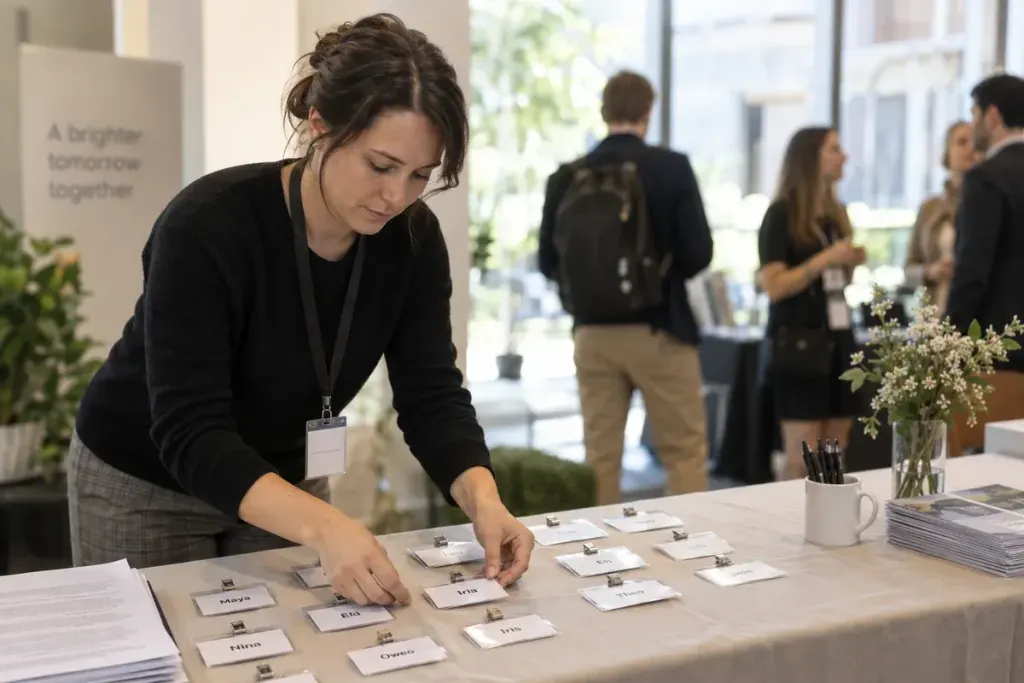
A name badge has a modest job: help two people begin a conversation without leaning forward to decipher tiny print. That job becomes harder when a sponsor mark, decorative border and three lines of credentials compete with the person’s name.
Before ordering a full batch, print a sample at its real size. Pin it to the intended lanyard or clip and read it from a normal conversational distance. A beautiful design on a large monitor can become a grey blur against clothing.
Make the name the easiest thing to find
Give the preferred display name the clearest position and strongest readable contrast. Place optional organisation or role information below it. Avoid using colour as the only way to communicate an attendee category: include a word or symbol with a clear explanation where the distinction is necessary.
Accessible materials are part of the wider event experience. Cornell’s accessible meeting and event checklist is a useful planning reference. The badge suggestions here are practical design choices, not a claim that one print layout satisfies every accessibility requirement.
Let guests decide what belongs on it
Ask for a display name rather than assuming the payment record contains the name someone wants colleagues to use. Offer pronunciation guidance or pronouns as optional fields, without making a blank response conspicuous. Do not add personal information merely because it exists in the registration system.
At check-in, provide a discreet correction process. A guest should be able to replace a badge without explaining their identity to a queue. Keep a small supply of legible blank badges and suitable pens for late changes. Assign someone who can resolve printing problems rather than leaving volunteers to invent inconsistent formats.
Attachment also matters. A lanyard that flips over hides the name; a clip may not work with every outfit. Offering a practical choice can be more useful than spending the same budget on elaborate decoration.
Finally, test the complete arrival sequence: find the guest, check the spelling, attach the badge and move on. If the design slows every registration, simplify it. The badge is successful when people use the name comfortably and then forget about the object that helped them start talking.